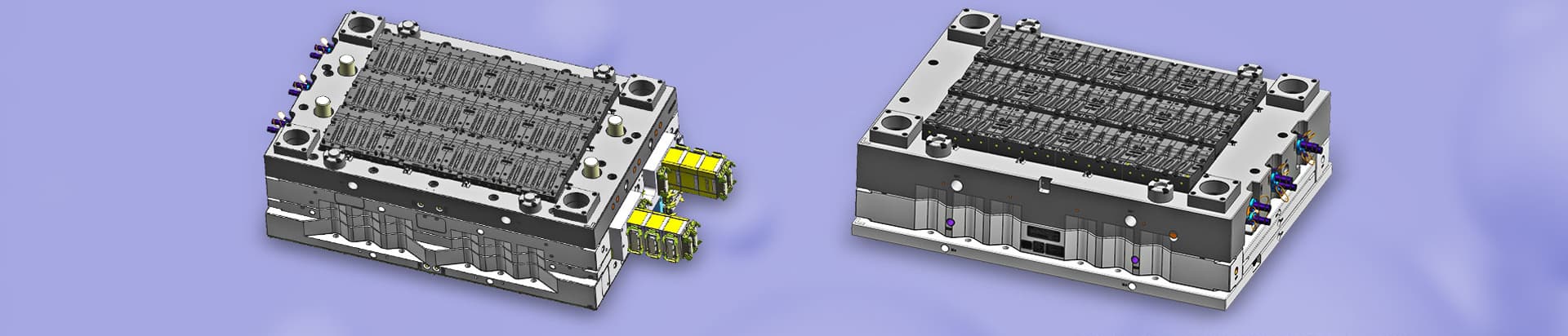
Surface scratches on injection-molded products commonly affect deep-cavity items like chargers, routers, and chassis. This issue plagues glossy or textured products, often misattributed solely to insufficient draft angles. However, solving scratches requires a deeper analysis of design, machining, and process factors.
Issue: Small draft angles (typically <5° for textured surfaces) cause friction during ejection, leading to sidewall scratches.
Solution: Apply specification-based draft angles (e.g., 3–5° for fine texture, 5–8° for coarse texture). If design constraints limit draft angles, implement mold mechanisms (slides, lifters) to avoid sticking.
Fillet Design Errors:
Product fillets at parting surfaces create near-zero draft angles, increasing scratch risk. Redesign fillets to maintain draft angles ≥2°.
Gate Placement Impact:
Locate gates away from textured sides to minimize pressure-induced warpage. High gate pressure (due to long holding times) increases clamping force, risking scratches.
Misalignment Risks: Poor core-cavity matching during mold opening causes abrasion. Ensure precise alignment through guide pins and bolster plates.
Product Adhesion Control: Guarantee 100% core adhesion during ejection. Use core fixings (undercuts, vacuum cups) to prevent cavity sticking and warpage.
Draft Angle Measurement Gaps:
Inaccurate angle measurements during machining reduce effective draft angles. Use precision gauges (e.g., protractors, 3D scanners) for verification.
Undercuts from Polishing:
Polishing near mold bases often creates undercuts, while parting surfaces may lose draft angles. Implement controlled polishing techniques (e.g., directional buffing) to maintain angles.
Excessive Pressures: High injection/holding pressures (e.g., >100 MPa) induce stress, causing warpage and sidewall contact. Reduce pressures step-by-step to balance filling and stress.
Temperature Effects: Overheated materials (e.g., >280°C for ABS) soften surfaces, increasing scratch susceptibility. Optimize barrel temperatures within material specs.
Inadequate Cooling: Insufficient cooling (e.g., <30% of cycle time) leads to soft parts that scratch easily. Extend cooling time until surface temperature <50°C.
Machine Aging: Worn injection machines with misaligned plates vibrate during opening, abrading parts. Regularly check plate parallelism and replace worn components.
Specify minimum draft angles based on texture roughness; avoid fillets at parting surfaces.
Position gates to minimize stress on textured areas; use fan gates for uniform flow.
Validate draft angles with precision tools during machining; implement anti-undercut polishing protocols.
Reinforce mold rigidity to prevent parting surface bulging (e.g., using hardened steel).
Tune injection parameters (pressure, speed, temperature) to reduce stress; monitor clamping force (<80% of machine capacity).
Maintain machine maintenance schedules to ensure plate alignment and minimal vibration.
Surface scratches in injection molding demand a systematic approach across design, manufacturing, and processing to ensure defect-free production of high-quality parts.
We specialize in custom plastic injection mold production service in China and injection molding processes for 20 years, contact yoyo@hanking-mould.com for your plastic products projects.


 Call us on:
  Email Us:
  1st Floor, Block1, No.3 Beiting Road, Houting Community, ShaJing Street, Bao'An District, Shenzhen City, Guangdong Province, China
  English
 Deutsch
 italiano
 русский
 français
 română
 العربية
 Español
 Polska
 日本語
日本語 한국어
한국어